Quick answer: can a GPS tracker follow a car across state lines?
Yes—crossing a US state border does not by itself stop a cellular GPS tracker that has nationwide service. The device still needs power, a usable satellite view, supported cellular coverage, an active subscription, and time to send its next scheduled report.
For an interstate vehicle, start with the route and service model rather than the state names:
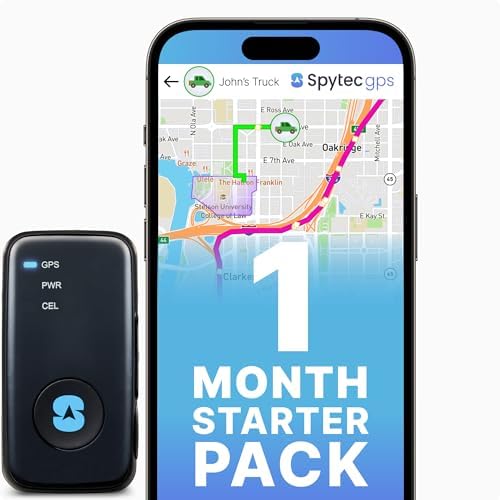
- Spytec includes US, Canada, and Mexico coverage on most current plans and offers portable or OBD models.
- LandAirSea advertises nationwide service and sells multiple reporting-speed tiers.
- Bouncie supports the US, Canada, and Mexico through its self-contained AT&T and T-Mobile connection, but requires a compatible OBD-II vehicle.
- Tracki advertises service in 185 countries and sells plans by update interval and prepaid term.
For cost, the shortest answer is:
- Lowest published 12-month service total: Spytec Pulse OBD at $107.40 on annual prepay, with the current direct-plan hardware included.
- Lowest flexible monthly service: Bouncie at $9.65 per month, after buying the current $89.99 device.
- Most reporting-speed choices: LandAirSea, with six tiers from three-minute to three-second reports.
- Lowest published two-year portable service totals: LandAirSea at $238.80 for three-minute reports and Tracki at $239.40 for one-minute reports, both before hardware.
“Nationwide” is not the same as continuous coverage on every road. Tunnels, parking structures, mountains, remote roads, metal-obstructed placement, weak cellular service, and an exhausted battery can delay a report. Test the device on a representative route before depending on it for theft recovery, a family trip, or business operations.
If you are choosing the product first rather than comparing service plans, start with our best GPS trackers for cars comparison. For a removable battery-powered device, use the portable GPS tracker comparison. If reporting frequency is the main question, see our real-time GPS tracker speed and cost guide.
Best GPS trackers for interstate trips: quick picks
The phrase “best tracker across state lines” describes a trip, not a single product category. These are route-fit starting points based on format and plan design — not a multi-state road test or a guarantee of coverage on every road.
| If your trip needs | A sensible starting point | What to confirm before you buy |
|---|---|---|
| A rechargeable tracker you can move between owned vehicles or equipment | Spytec Atlas Portable | Your route, the selected reporting plan, expected battery runtime, and a secure weather-appropriate mounting method. |
| A tracker for one compatible daily driver with no routine charging | Spytec Pulse OBD | OBD-II compatibility, a clear port, the active plan, and whether the vehicle will remain powered as expected. |
| A simple OBD option with month-to-month service | Bouncie | Vehicle compatibility, current monthly terms, reporting needs, and whether its vehicle-data features matter to you. |
| A compact portable tracker where broader travel is part of the brief | Tracki 4G | The provider’s current destination coverage, plan terms, battery expectations, and the frequency you need updates. |
For a one-car daily setup, the vehicle-powered options are usually easier to maintain. For an owned asset that changes vehicles or sits without an OBD port, a rechargeable portable tracker can be the better fit. In both cases, test the app before departure rather than treating the first day of a long drive as setup time.
US coverage comparison
The table summarizes each provider’s current published position. These are manufacturer claims, not the result of a single independent drive test.
| Provider | Published service area | Connection details | Main limitation to check |
|---|---|---|---|
| Spytec | Most plans include the US, Canada, and Mexico | Portable and OBD trackers use cellular service to send location reports | Confirm remote routes and destinations beyond North America |
| LandAirSea | Nationwide US use and service in more than 155 countries are advertised | Rechargeable tracker; reporting interval depends on the selected plan | Battery runtime, device placement, and the chosen update tier |
| Bouncie | US, Canada, and Mexico | Internal SIM uses AT&T and T-Mobile 4G data networks in the US | OBD-II compatibility and carrier reception on the actual route |
| Tracki | Operation in 185 countries is advertised | GPS, cellular, and Wi-Fi positioning; service required per device | Check the current unsupported-country list and battery settings |
For trips inside the US, a provider’s service area is only the first filter. Review the actual carrier map where the provider identifies its networks, then account for the places the car will spend time: underground garages, enclosed trailers, rural highways, mountain roads, and border areas can behave differently from an open urban road.
How to check an interstate route before relying on a tracker
- List the highways, overnight stops, garages, and rural areas that matter—not only the destination state.
- Check the provider’s own coverage documentation. If the provider names its cellular networks, compare those carrier maps with the route.
- Confirm roaming or international terms separately when the trip may enter Canada or Mexico.
- Install the tracker according to the provider’s signal and weather guidance, then drive a representative local route.
- Verify that location reports, geofence alerts, and reconnect behavior appear as expected before the important trip.
This route test does not prove that every mile will have service, but it is more useful than treating a nationwide coverage claim as a guarantee.
12-month subscription cost comparison
This table uses official US prices checked July 31, 2026. “Monthly for 12 months” multiplies the cancel-anytime monthly charge by 12. “Annual prepay” is the amount paid upfront for a one-year plan. Taxes, shipping, optional accessories, promotional discounts, and separately purchased hardware are excluded unless stated.
| Tracker and interval | Monthly service × 12 | Annual prepay | First-year direct total |
|---|---|---|---|
| Spytec Atlas Portable, up to 5-second reports | $419.40 | $275.40 | $275.40 on annual prepay; current hardware included |
| Spytec Pulse OBD, up to 1-second reports | $179.40 | $107.40 | $107.40 on annual prepay; current hardware included |
| LandAirSea 54, 3-minute reports | $239.40 | $179.55 | At least $179.55 plus the current device price |
| Bouncie, standard single-device service | $115.80 | No annual discount shown | $205.79 using the current $89.99 direct device price |
| Tracki 4G, 1-minute reports | $239.40 | $167.40 | At least $167.40 plus the selected hardware and accessories |
The lowest service total in this specific comparison is Spytec Pulse OBD on annual prepay, but it is not automatically the lowest-risk choice. It requires a compatible OBD-II port, remains visible at that port, and the lower rate requires paying the year upfront. Bouncie costs slightly more for service and requires buying the device, but it includes driving events and vehicle diagnostics in a simple monthly plan.
The portable products solve a different installation problem. Spytec Atlas includes its current direct-plan hardware, while LandAirSea and Tracki generally separate hardware from service. Compare first-year total cost, not only the displayed monthly equivalent.
Billing flexibility and cancellation terms
The lowest displayed monthly equivalent often requires the largest upfront commitment. These are the current published plan structures, not a promise that taxes, refunds, or renewal rules will remain unchanged.
| Provider | Flexible option | Prepaid commitment |
|---|---|---|
| Spytec | Monthly plans can be cancelled without a cancellation fee | Annual rate is paid upfront; cancelling stops renewal but service continues through the paid term |
| LandAirSea | Month-to-month service can be cancelled | Prepaid 6-month, 1-year, and 2-year terms cannot be cancelled or paused |
| Bouncie | Monthly subscription can be cancelled at any time | No annual discount is currently shown on the public pricing page |
| Tracki | Monthly plan is available per device | Long-term plans are billed upfront and renew automatically; confirm the cancellation deadline before renewal |
Choose monthly service when you are testing compatibility or only need seasonal tracking. Choose a prepaid term only after the device, alerts, route coverage, and battery routine have worked in your own use case.
What does a GPS tracker subscription pay for?
The subscription is not payment for satellite signals. It generally pays for the cellular connection that sends the tracker’s location to the provider, access to the app or web portal, storage for trip history, alerts such as geofences or speed events, and provider support. The exact feature set and history retention vary, so compare what is included rather than assuming a faster or more expensive plan unlocks the same features everywhere.
A tracker can still receive a location fix without a working data connection, but the app cannot show a fresh remote report until the device sends that data. That difference explains why active cellular GPS service normally has a recurring cost while an AirTag uses a different, crowdsourced network model.
How reporting speed changes the price
An update interval is the shortest scheduled time between reports under the selected plan and settings. It is not a promise that every report will reach the app at exactly that interval. Network delay, sleep settings, lack of movement, placement, and battery-saving modes can change what you see.
Spytec
Spytec’s current pricing ties the fastest published reporting interval to the tracker model:
| Model | Fastest published interval | Month to month | Annual prepay |
|---|---|---|---|
| Atlas Portable | 5 seconds | $34.95/month | $275.40/year |
| Pulse OBD | 1 second | $14.95/month | $107.40/year |
Atlas is rechargeable and easier to relocate. Pulse draws power from the vehicle and adds diagnostics, but it must remain plugged into a compatible OBD-II port. For a detailed look at the rechargeable option, read our Spytec Atlas review.
LandAirSea
LandAirSea’s plan table changes price with reporting frequency. Its month-to-month options currently begin at $19.95 for three-minute reports and rise as the interval becomes shorter. A one-year prepayment receives the published 25% discount.
| Reporting interval | Month to month | One-year prepay |
|---|---|---|
| 3 minutes | $19.95/month | $179.55 |
| 1 minute | $24.95/month | $224.55 |
| 30 seconds | $34.95/month | $314.55 |
| 10 seconds | $39.95/month | $359.55 |
| 5 seconds | $44.95/month | $404.55 |
| 3 seconds | $49.95/month | $449.55 |
LandAirSea also publishes a two-year prepay at a 50% discount: the three-minute tier totals $238.80 for two years. Monthly service can be cancelled, while LandAirSea says prepaid terms cannot be cancelled or paused. Pick the slower plan if periodic status is enough; pay for faster reports only when the operational need justifies the extra cost and battery demand.
Bouncie
Bouncie currently lists an $89.99 device and a $9.65 monthly subscription for one device, with no activation fee or contract. Accounts with three or more devices receive a lower per-device rate.
Bouncie plugs into the OBD-II port and uses vehicle power. It is better compared with Spytec Pulse than with a rechargeable magnetic tracker. Its service includes trip history, driving-event alerts, geo-zones, and diagnostics rather than a menu of reporting-speed price tiers.
Tracki
Tracki prices plans by interval and term. Each device requires its own subscription, and longer terms are billed upfront.
| Reporting interval | Month to month | One-year prepay |
|---|---|---|
| 1 minute | $19.95/month | $167.40 |
| 30 seconds | $24.95/month | $209.58 |
| 15 seconds | $29.95/month | $251.58 |
Tracki recommends a larger battery configuration for the faster 30-second and 15-second plans. That makes the interval a battery and size decision as well as a price decision.
What “nationwide coverage” does not guarantee
A cellular tracker completes two separate jobs: it estimates location from satellite signals and sends data through a supported network. Either part can be interrupted.
- No clear satellite view: Metal enclosures, covered parking, dense buildings, or poor placement can reduce positioning quality.
- No supported cellular connection: A location may not appear in the app until the tracker reconnects.
- No power: A discharged portable tracker or disconnected OBD device cannot keep reporting.
- A slower plan or sleep mode: The app may be showing the last scheduled report, not the vehicle’s present position.
- An inactive account: Cellular reporting stops when required service is cancelled or payment fails.
This is why the correct pre-trip question is not only “does it work in this state?” Ask whether the provider supports the route, whether the device has the right installation and battery strategy, and how quickly the selected plan is designed to report.
Which plan fits each use case?
Interstate family vehicle
Choose an OBD product when the vehicle is compatible and avoiding battery maintenance matters. Bouncie is the simpler month-to-month option; Spytec Pulse has the lower published annual service total. Confirm the route’s cellular coverage and test notifications before the trip.
Rechargeable tracker moved between vehicles
Spytec Atlas is the more predictable direct-plan package because current service includes the hardware and magnetic case. LandAirSea gives more reporting-interval choices. Tracki is compact and offers international reach, but faster plans require more battery attention.
Our portable tracker guide compares these installation and battery tradeoffs directly rather than ranking them only by subscription total.
Small fleet
Separate the device decision from the account decision. Confirm multi-device pricing, shared access, export features, alert controls, hardware replacement terms, and whether each tracker needs its own paid line. Bouncie publishes a lower monthly rate for three or more devices; the other providers use their own device and term structures.
Theft-recovery layer
Use a tracker only as one layer of vehicle security. It can provide recent location information when power, reception, placement, and service cooperate, but it cannot guarantee recovery. If a vehicle is stolen, give the available information to law enforcement rather than attempting recovery yourself.
Is there a no-subscription alternative?
Apple AirTag 2 does not require a tracking-service subscription, but it is not a cellular GPS tracker. It uses Bluetooth, compatible Ultra Wideband hardware for nearby Precision Finding, and Apple’s Find My network to help locate personal belongings. It does not offer the scheduled reporting intervals or service-area model in the tables above.
Choose an item finder when the job is finding your own keys, bag, or another belonging. Choose a cellular GPS tracker when the requirement is scheduled remote vehicle reports, route history, geo-zones, or diagnostics. Our Spytec vs Tracki vs AirTag comparison explains the category difference in more detail.
For the full trade-off between no-fee item finding, prepaid service, and remote cellular updates, see GPS trackers with no monthly fee: what actually works for cars.
Checklist before buying
- Confirm the provider supports every country and route that matters to you.
- Check the provider’s carrier map when one is published; do not rely only on the word “nationwide.”
- Decide whether the tracker should be portable, OBD plug-in, or permanently installed.
- Compare the full first-year total: hardware, service, required case, shipping, and tax.
- Check whether a discounted plan is billed upfront and whether it can be cancelled or paused.
- Match reporting frequency to the use case instead of automatically buying the fastest tier.
- Plan for charging, vehicle-battery use, or tamper/disconnection risk.
- Install and use the device only on a vehicle or asset you own or have explicit permission to monitor.
- Test location reports and alerts on familiar roads before relying on the tracker during an important trip.
If installation format is still the sticking point, compare OBD and magnetic GPS trackers before narrowing the plan options.
Research notes and sources
We have not run a controlled multi-state drive test of these services. Coverage, plan, and update-interval statements come from current official provider pages and support documentation. Prices were checked July 31, 2026 and can change.
Primary sources: Spytec pricing, Spytec portable coverage, LandAirSea pricing, LandAirSea support, Bouncie pricing, Bouncie coverage FAQ, Tracki subscription plans, and Tracki model and coverage comparison.
Affiliate disclosure: BetterPickAdvisor may earn a commission from qualifying purchases made through some links on this site. Provider links in this guide are included to document current coverage and pricing; the calculations above are our own arithmetic from those published prices.