Quick answer
If you need scheduled location reports in an app while your car is away from you, a true cellular GPS tracker normally needs a paid service plan. The recurring cost pays for the mobile-data connection, the provider’s app, alerts, and stored trip data. Removing the monthly fee usually means choosing a different type of product, not finding the same service for free.
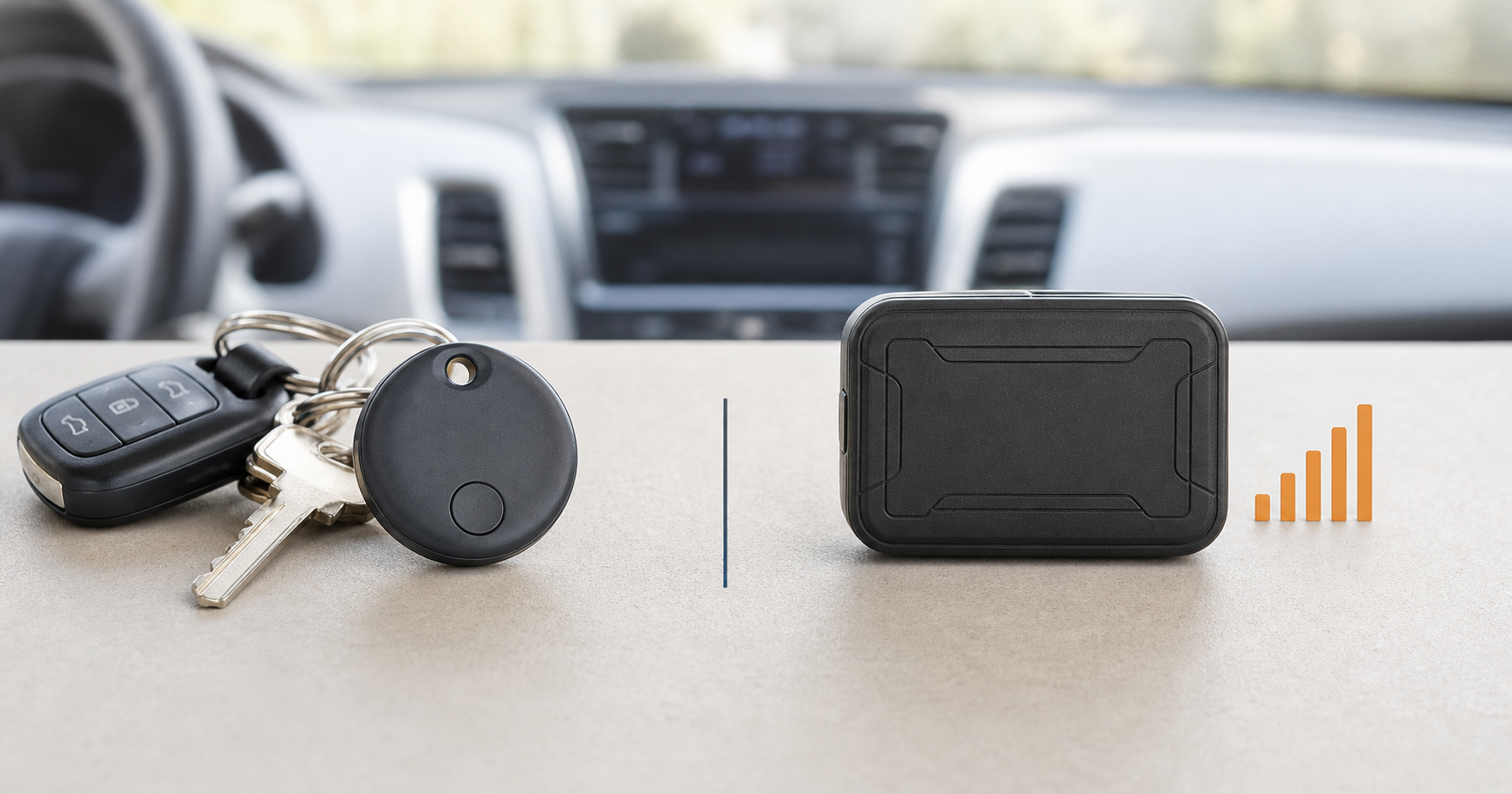
For an owned personal item that you only need to locate occasionally, an AirTag can be useful because it works through Apple’s Find My network and has no tracking-service subscription. It is not a cellular car tracker: it does not let you choose a reporting interval or promise a fresh location when no compatible Apple device is nearby.
Before comparing brands, decide which of these three categories you actually need.
“No monthly fee” can mean three different things
| What a listing may mean | What you get | What you do not get |
|---|---|---|
| No recurring tracking service | An item finder such as AirTag, using nearby devices in a crowdsourced network | Scheduled cellular reports, a provider coverage plan, or controlled update intervals |
| Prepaid service | A lower monthly equivalent when you pay several months or a year in advance | A free service; the full term is paid up front and cancellation terms can be stricter |
| Local route logging | Location records stored on the device for later retrieval | A live remote map, current alerts, or a fresh location when you are away from the car |
The distinction matters because “GPS” describes how a device can estimate location; it does not describe how that location reaches you. A cellular tracker needs a data connection to send a remote report. An item finder depends on a different network. A data logger may have no service fee because it does not send anything until you retrieve it.
When an AirTag is the better choice
An AirTag is worth considering when the goal is finding an owned personal belonging rather than monitoring a vehicle’s route. Apple describes AirTag as an item finder that uses Bluetooth and the Find My network; compatible nearby Apple devices can securely relay a location to the owner.
Choose this category when all of these are true:
- You want occasional help locating a personal item that belongs to you.
- You use Apple’s Find My ecosystem and understand that nearby devices affect updates.
- You do not need selected reporting intervals, geofences, driving information, or trip history from a tracking provider.
- You are comfortable with a last-known or delayed location rather than treating it as live vehicle telemetry.
Apple also builds unwanted-tracking protections into the Find My ecosystem. Use an item finder only with belongings, vehicles, or assets you own or are explicitly authorized to monitor.
Sources: Apple on AirTag and Find My and Apple’s unwanted-tracking protections.
When a cellular tracker is worth the recurring cost
A service plan is usually the better fit when you need the tracker to send information on its own while the vehicle is elsewhere. That can include scheduled reports, route history, speed or geofence alerts, shared access, and vehicle diagnostics on some OBD devices.
| Requirement | Better category | Why |
|---|---|---|
| Current reports during a multi-state drive | Cellular GPS tracker with an active plan | It can send reports over the provider’s supported mobile-data service when power and coverage are available. |
| Regular reports from one compatible daily vehicle | OBD cellular tracker | It uses vehicle power, so separate tracker charging is not part of the routine. |
| A tracker moved between owned vehicles or equipment | Rechargeable portable cellular tracker | It is easier to relocate, but battery maintenance becomes part of the choice. |
| Occasional help finding a personal belonging | Item finder | It avoids a cellular tracking plan but operates through a different network and update model. |
No option guarantees a fresh report in every tunnel, garage, rural road, or covered parking area. For longer trips, compare the expected route, power source, active-plan status, and reporting interval before relying on any device. Our car GPS tracker coverage and subscription guide explains those checks in detail.
Lower the cost without misleading yourself
The most useful comparison is not “monthly fee versus no monthly fee.” It is the full first-year cost for the service model you actually need.
- Compare hardware and service together. Some providers include hardware with a direct service plan; others sell it separately.
- Compare the same reporting need. A slower update tier may cost less and use less battery, but it may not meet the reason you wanted tracking.
- Treat annual prepay as a commitment. It can reduce the monthly equivalent while requiring the full term upfront.
- Read cancellation and renewal terms. A low monthly equivalent is not helpful if the tracker has not worked in your vehicle or on your route.
- Test before committing. Confirm the app, alerts, route history, and power routine during normal use before relying on the setup for an important trip.
Our best GPS trackers for cars comparison puts the common cellular options side by side, while the real-time GPS tracker guide explains why a fast advertised interval is not the same as a guaranteed live map.
A simple decision guide
| Start with this question | If the answer is yes | Start here |
|---|---|---|
| Do I need the device to send scheduled reports while I am away? | You need remote cellular data, not only a location stored on the device. | Compare a cellular tracker and its active plan. |
| Do I only need to find a personal belonging occasionally? | You may not need a cellular tracking subscription. | Compare an AirTag or another item finder, including its network limits. |
| Do I need to avoid charging a separate tracker? | Vehicle power matters more than portability. | Compare an OBD tracker with your vehicle’s compatibility. |
| Do I need to move the device between owned assets? | A portable format may be more useful than OBD power. | Compare rechargeable trackers and plan for charging. |
If your choice is now between a powered plug-in and a rechargeable portable device, read OBD vs magnetic GPS tracker: which type fits your car?.
Use tracking responsibly
Only use a tracker or item finder on a vehicle, personal belonging, or asset you own or have explicit permission to monitor. Do not rely on a consumer tracker as a safety guarantee or attempt vehicle recovery yourself; share relevant information with law enforcement when appropriate. Local laws, employer policies, lease terms, and family agreements can also affect what monitoring is permitted.
Research notes and related guides
This is a research-based category guide, not a lab test of individual trackers. It uses Apple’s current Find My documentation and the official plan documentation linked in our coverage and subscription comparison. Product plans, prices, and network terms can change, so verify them at checkout.
- Best GPS trackers for cars
- Car GPS tracker coverage and subscription plans
- Real-time GPS tracker: update speed, app delay, and cost
- OBD vs magnetic GPS tracker
Affiliate disclosure: BetterPickAdvisor may earn a commission from qualifying purchases made through some links on this site. This guide focuses on category trade-offs; linked provider documentation is included to explain how the services work.